
The Constraint Simplex
Cutting Through Tech Hype and Understanding the Limits of What’s Possible

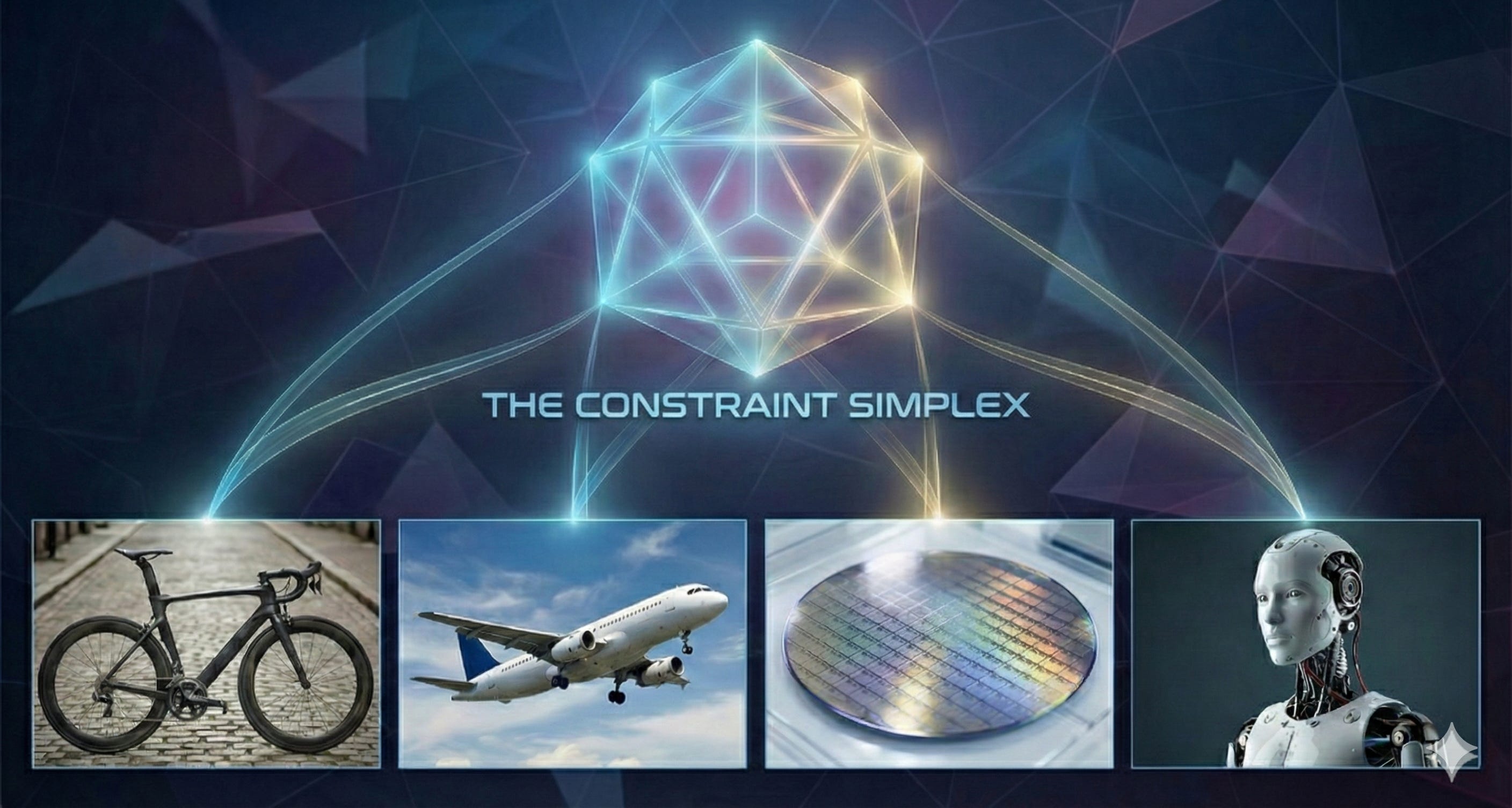
I’ll start this post with a small admission: I use AI extensively in my writing. I’ll save the details for another time, but while working through a line of thought recently, the chatbot I use surfaced a term that stopped me in my tracks because it captured exactly what I was trying to express.
That term is the constraint simplex. It sounds a bit jargony, but it neatly wraps up a straightforward idea: as any complex technology evolves, it eventually runs into hard constraints. As the system reaches constraints, pushing further in one direction forces trade‑offs in another, or further progress becomes physically or economically impossible within the current architecture.
A simplex is a geometric term for the simplest flat‑sided shape that can enclose a space. In two dimensions, it’s a triangle. In three, a tetrahedron. And because geometry isn’t limited to three dimensions, you can keep going, four‑dimensional simplexes, five‑dimensional simplexes, and so on.
I hadn’t encountered the word before, but because my mind tends to work in geometric terms, the AI picked up that pattern and suggested it. It fit immediately; conceptually clean, visually intuitive, and with a nice ring to it.
So, the constraint simplex is simply the multi‑dimensional possibility space a technology can evolve within until it runs into the “faces” where further progress becomes constrained or forces steep trade‑offs.
This pattern shows up everywhere; in passenger and freight vehicles, solar panels, EV batteries, and countless other technologies.
And once you start looking at the physical, economic, and practical constraints that define those boundaries, you suddenly have a powerful lens for cutting through hype and seeing what’s actually possible.
The Bicycle
To illustrate the idea, let’s go back to one of my favorite examples from Emergent Systems Theory: the bicycle. I’ve argued that the basic form of the modern bike; two wheels, the rider centered between them, reciprocating pedals, a steerable front wheel with handlebars is a kind of attractor. It’s a persistent pattern that has endured because it evolved into the best form for allowing humans to move under their own power with speed, stability, and efficiency.
Although there are variations, the classic “double‑diamond” frame has been the standard for nearly 150 years. It represents the best set of trade‑offs across safety, comfort, speed, stability, and cost. These are basically the dimensions of the constraint simplex for bikes. In the vast possibility space of what a bicycle could look like, this shape has proven to be the one that best satisfies all those constraints.
If we take it a step further and look at performance, there’s an old adage in the cycling world: strong, light, cheap, pick two. If you want something strong and light, it will be expensive. If you want strength at low cost, it will be heavy. If you want light and cheap, it will be weak. These are all trade‑offs rooted in material properties and manufacturing realities. Nature doesn’t hand out free lunches. These three dimensions define the performance constraint simplex for the bicycle.
This principle shows up in every technological system. When something is first invented, it may take time to discover where the boundaries of its simplex lie, but eventually, they always reveal themselves.
Aviation Example
Let’s take another example: the development of commercial aviation. Early practical aircraft could manage maybe 100 mph and stay aloft for an hour or so. As we learned the basic physics of flight, refined aerodynamic configurations, and improved engines and propulsion, speeds climbed. By WWII, transport aircraft were cruising at 250–300 mph with ranges of several hours. The main limitation at that stage was power. Large piston engines were heavy, complex, and not especially reliable.
The invention of turbine power, the jet engine, created a genuine step change. With far more power available, aircraft could fly faster, grow larger, and carry more fuel. By the 1960s, typical commercial speeds had reached about 550 mph. And interestingly, they haven’t increased much since.
Engines have continued to improve, though at a slower pace, enabling larger aircraft and longer ranges. But other constraints have taken over.
On the speed front, the sound barrier is the big one. You can fly faster than sound, but frictional heating rises sharply, creating materials challenges, and fuel consumption becomes exponential. Those physics have economic consequences. The Concorde, developed in the 1970s, proved the point. It worked technologically, but the cost to save a few hours on a transcontinental trip wasn’t worth it for most travelers. As a result, commercial aircraft speeds have been essentially flat for 60 years.
There have been attempts to revisit these hard limits in the last decade, but none have cracked the underlying physics. Boom Supersonic’s recent pivot to ground‑power units looks, to me, like a sign they’ve run into the same wall.
On other fronts, more efficient engines have enabled bigger aircraft and longer ranges, but those dimensions have their own boundaries. People don’t enjoy being confined in a small space for 17+ hours. And the route logistics for something like the A380 with over 500 passengers only work in a handful of places. So we’ve likely hit practical limits on both range and size.
Commercial aviation has reached the boundaries of the system it operates within; speed, load, cost, range. It functions beautifully inside that space, but when you try to push past those boundaries, the trade‑offs become steep very quickly.
What is Moore’ Law, Really?
Let’s now shift to a much smaller domain: semiconductor manufacturing.
Moore’s Law, the famous observation that semiconductor capability doubles roughly every 18 months is often treated as if it were a natural law, something inevitable and unbounded. It isn’t that. What it really reflects is an industry‑wide learning curve. The idea of the learning curve originally came from studies of labor improvements in aircraft manufacturing, but the principle is simple: when people repeat a complex task over and over, they get better at it, and they invent new ways to keep improving.
That’s essentially what has been happening in semiconductor fabrication for the last 50 years. Each generation exposed new bottlenecks, engineers solved them, and those solutions set up the next generation. It wasn’t a law of nature, it was a feedback loop of learning, investment, and economic incentive. It kept going because there was money to be made in keeping it going.
But now we’re down to the 3‑nanometer scale. At that size, we’re running into real physical constraints with current materials. Quantum effects increase leakage. Power densities rise to the point where heat removal becomes a major challenge. And many of the hardest limits now show up not in the silicon itself but in the packaging; how you connect, cool, and integrate these tiny structures.
In other words, we’re starting to hit the physics face of the constraint simplex for semiconductors. Can these problems be overcome? Maybe. But likely at very high cost, or with trade‑offs somewhere else.
When systems hit these kinds of boundaries, they often begin exploring new architectures. In computing, that shift was already underway for other reasons with the rise of parallelism and graphics processing units (GPUs). Over the next few years, we may see less emphasis on shrinking transistor dimensions and more emphasis on high‑bandwidth memory, interconnects, and packaging which now appear to be the dominant constraints, especially for LLM‑based AI.
Applying the Constraint Simplex to Humanoid Robots
At the beginning of this piece, I said we could use the constraint simplex to sort out which technological visions are achievable and which are mostly hype. So let’s take humanoid robots as a test case.
Evolution has had roughly 600 million years to shape the human form. It may be blind, but it isn’t dumb, and the human body is remarkably good at doing the things humans need to do. But that doesn’t mean the tasks humans perform need to be done by machines that look like humans. You can probably see where this is going…
Most of the current discourse around humanoid robots focuses on using transformer architectures and reinforcement learning to train robots to navigate, maneuver, and manipulate in complex spaces. That work is important, and much of it will transfer to other robot forms. But the real faces of the constraint simplex show up in physics.
A big one is energy. Biological systems are astonishingly good at storing and converting chemical energy into motion and activity. Batteries, by comparison, are heavy and bulky. And bipedal motion driven by motors, gears, and actuators is inherently inefficient. The stop‑start nature of walking is exactly what electric motors dislike. Compared to wheels, bipedal locomotion is only about ten percent as efficient. That’s why most practical robots are wheeled or tracked unless they absolutely must traverse irregular terrain.
Battery storage is also hitting its own simplex faces. As a result, most humanoid robots today run for only a few hours under load. You either need a fleet that can rotate through charging cycles or swappable battery packs, each with its own trade‑offs.
So what’s the practical approach? Use wheels or tracks and modify the environment so robots can operate efficiently. That’s what factories and warehouses already do. It dramatically increases runtime and load capacity. Bipedalism only makes sense in environments that can’t be modified and even then, quadrupeds are usually better. Most land animals figured that out a long time ago.
Hands present another set of constraints. Human hands are extraordinarily capable manipulators, with integrated sensing; touch, temperature, texture, force feedback and a huge number of degrees of freedom. They’re also incredibly strong for their size. Muscle can generate more tension per square inch of cross section than almost any human‑made actuator. That’s why robotic “effectors” tend to be claws, grippers, or suction devices. Fine dexterity is still out of reach, both physically and from a control standpoint.
So, engineers do what engineers always do: specialize and modify the environment. Look at Japan and Korea; they’ve developed a wide range of specialized robots for food service, cleaning, and logistics.
Can a robot clean a toilet? Probably not. But you can design a self‑cleaning toilet. That’s the direction those countries are heading as their populations age and shrink.
As you explore the simplex, humanoid robots only make sense in environments that can’t be adapted for other approaches. And the capabilities that would make them most useful in those environments, especially dexterous hands, aren’t close. That means tasks like elder care, loading your dishwasher, or picking up after your kids will remain human activities. And maybe that’s the way it should be.
Every technology lives inside a possibility space shaped by physics, materials, energy, economics, and human needs. The constraint simplex is simply a way of making those faces visible; the places where progress slows and the edges where new architectures start to emerge.
Humanoid robots sit right at those edges. And when you look at the constraints, the picture of where they actually fit becomes much clearer.
So what do you think? Does the constraint simplex help dig a level deeper and separate what’s real from what’s hype? Or am I wrong and we’ll see fleets of humanoid robots in factories in the near future? I’d love to hear your thoughts, please comment below.
A very compelling lens.
What stood out to me is not so much where the physical or engineering boundaries of humanoid robotics lie — that discussion clearly belongs to those domains — but how the idea of a *constraint simplex* translates into socio-technical systems.
In practice, technological viability is rarely defined by physical constraints alone. It is co-shaped by cognitive environments, cultural expectations, infrastructural compatibility, and the interpretive frameworks through which humans encounter technology.
From that perspective, humanoid robotics may operate within at least two overlapping possibility spaces:
one defined by mechanical efficiency, and another defined by social intelligibility and acceptance.
A form that appears suboptimal in purely physical terms can still persist — or even dominate — because it minimizes friction within human cognitive and environmental ecosystems.
Seen this way, the interesting question becomes less *“Is the humanoid form optimal?”* and more *“Optimal relative to which constraint space?”*
That reframing makes the simplex concept particularly generative beyond engineering contexts.